Why we based the NPD service on the NPQ service
Summary
We chose to base the NPD registration service on the existing NPQ service.
This gave us a proven foundation and allowed us to focus on the areas of highest risk.
Why we started with NPQ
NPD and NPQ services are very similar
Both services:
- let participants register for a course
- determine funding eligibility
- pass data to providers
- support providers to manage participants and delivery
- allow providers to get paid for delivering the course

Many of the underlying processes are shared
Because the NPD Reception course is delivered through the same commercial framework as NPQs.
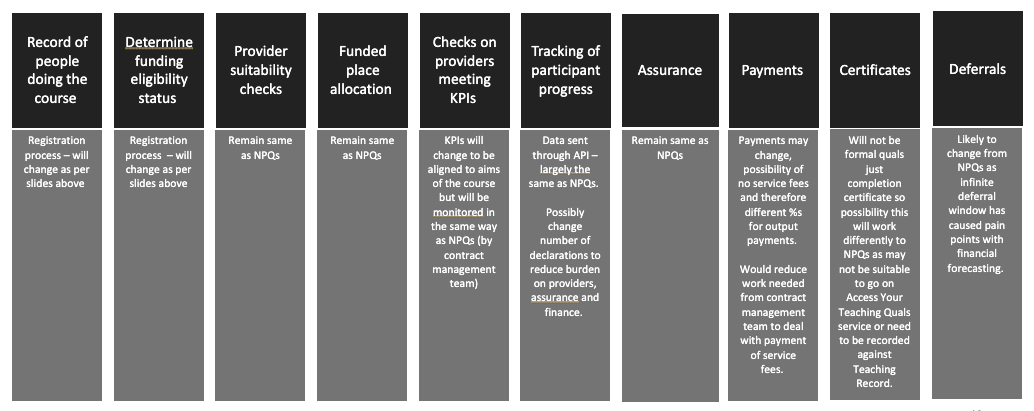
But there are some differences
| NPQ policy | NPD policy |
|---|---|
| Different prices for specialist and leadership courses | Single NPD price (different to NPQs) |
| Outcome fees split equally across declarations | Outcome fees split 60% / 40% |
| 3 or 4 declarations per course | 2 declarations per course |
| Deferrals can be indefinite | Deferrals limited to 12 months |
| NPQs are qualifications | NPDs are not qualifications |
| Complex funding eligibility rules | Simpler eligibility (no manual review required) |
| Around 10 NPQ courses | Initially 1 NPD course |
| Programme name is NPQ | Programme name is NPD |
| Audience: leadership or aspiring leaders | Audience: experienced teachers |
A well established service
The NPQ service is already live and widely used.
It has:
- been running for several years
- supported over 150k registrations
- been through multiple rounds of user research
This means we already understand:
- how users move through the journey
- where they get confused
- what works well
Basing NPD on NPQ meant we could build on this existing insight rather than starting from scratch.
What we decided and how it shaped our approach
We chose to reuse the NPQ service as our starting point, rather than building a new service from scratch.
We simplified it where NPD rules are different, and kept NPD separate so we could adapt it over time without impacting NPQ.
This approach:
- reduced delivery risk, cost and effort
- allowed us to use established patterns and components
- avoided re-solving well understood problems
It also shaped how we approached design and research.
Instead of re-testing everything, we focused on:
- simplifying the registration journey
- removing unnecessary steps
- adapting the service for a different user group
- addressing known pain points from NPQ
We used existing research to validate decisions quickly and prioritise changes.
Focusing on the riskiest areas
By reusing a proven service, we could focus our effort on new or unclear areas, such as:
- how users understand the end-to-end process
- how policy changes translate into digital journeys
- more complex paths like deferrals and changing provider
Rather than rebuilding everything, we targeted the areas where:
- user needs were least well understood
- policy introduced new complexity
- the risk of failure was highest
What we learned
Starting with an existing service gave us speed and confidence.
It allowed us to focus on what was different, rather than re-solving what was already known.
Using proven patterns alongside targeted iteration helped us reduce risk while still improving the experience.